You get your thyroid panel back. The report says “within normal limits.” And yet you’re still exhausted by noon, losing hair, and struggling to string a sentence together. If that sounds familiar, you’re not imagining it, and you’re not alone. Understanding your thyroid lab results goes far beyond confirming that a number landed inside a reference range printed on a piece of paper.
One of the most consistent gaps dietitian Nataliia sees in her Hashimoto’s clients at All Purpose Nutrition is that they’ve never received a real explanation of their own lab numbers. That’s exactly why a dedicated lab review session is built into every coaching program. This guide breaks down what each marker actually measures, how to read common patterns in your thyroid lab results, and where standard reference ranges fall short for people with autoimmune thyroid disease.
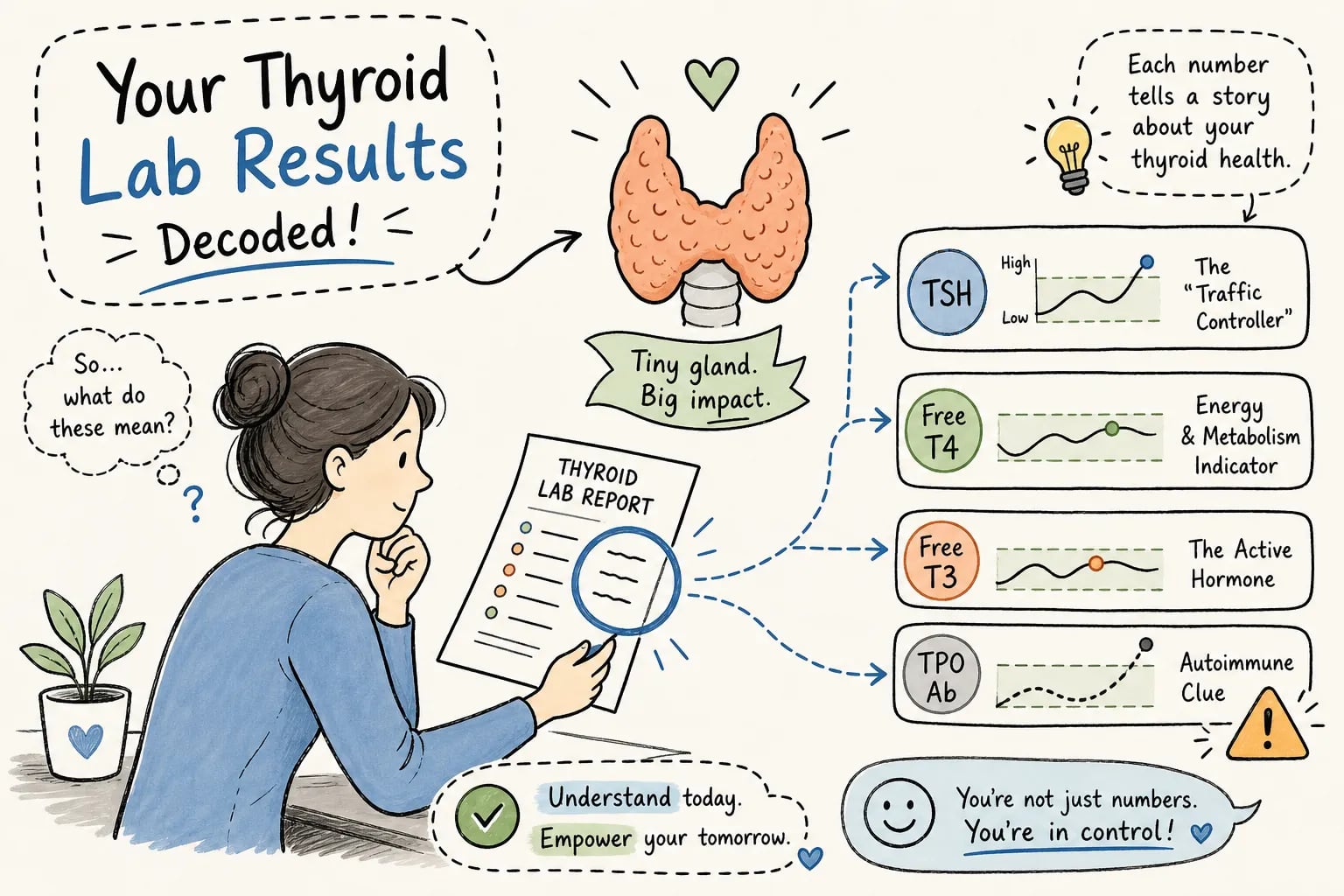
What Each Marker on a Thyroid Panel Actually Measures
A thyroid panel is not a single number. It’s a set of hormone signals, each capturing a different point in the feedback loop between your brain, pituitary gland, and thyroid. Reading one marker in isolation is like reading one sentence from the middle of a paragraph and trying to guess the plot of the whole book.
TSH: The Signal From Your Pituitary, Not Your Thyroid
TSH, or thyroid-stimulating hormone, is produced by the pituitary gland, not the thyroid itself. When the pituitary senses that thyroid hormone output is too low, it raises TSH to push the thyroid harder. When hormone levels are adequate, TSH backs off. The standard reference range for most adults is roughly 0.4, 4.5 mIU/L, though this varies by lab. What TSH does not tell you is how much active thyroid hormone is actually circulating in your blood or getting into your cells.
Free T4 and Free T3: The Hormones Doing the Actual Work
Free T4 (reference range approximately 0.7, 1.8 ng/dL) is the main hormone the thyroid secretes directly. Free T3 (reference range approximately 2.0, 4.4 pg/mL) is the active form that enters cells and drives metabolism, energy production, mood, and cognitive function. The key relationship: T4 must convert to T3 in peripheral tissues like the liver, gut, and muscles. That conversion step can be impaired even when free T4 looks perfectly adequate, which is one of the main reasons someone can have “normal” thyroid lab results and still feel terrible.
TPO and Thyroglobulin Antibodies: Markers of Immune Activity
TPO antibodies (TPOAb, reference typically below 34 IU/mL) and thyroglobulin antibodies (TgAb) indicate that the immune system is actively targeting thyroid tissue. These are the markers that confirm an autoimmune process like Hashimoto’s thyroiditis. Elevated antibodies can exist even when TSH and free hormone levels appear technically normal, meaning the thyroid is still under immune attack before standard hormone tests shift. Many standard panels do not automatically include antibody testing, so you may need to ask for it specifically.
How to Interpret Your Thyroid Lab Results
Individual markers become meaningful when read together as a pattern. Each combination points toward a different diagnosis, and missing one piece of the picture leads to incomplete conclusions.
Primary Hypothyroidism vs. Subclinical Hypothyroidism
A high TSH combined with a low free T4 indicates overt primary hypothyroidism: the thyroid is producing insufficient hormone, and the pituitary is compensating by pushing harder. A high TSH with a normal free T4 signals subclinical hypothyroidism, where free hormones are still within range but the pituitary signal is already elevated, indicating early-stage underfunction. Hashimoto’s thyroiditis is the most common cause of primary hypothyroidism in the United States, making antibody testing essential context for either pattern. These are the hypothyroidism lab values your provider should be reviewing alongside your symptoms, not just checking off against a reference range.
Hyperthyroidism and the TSH Suppression Pattern
When TSH is low and free T4 is high, that points to overt hyperthyroidism or thyrotoxicosis. Excess thyroid hormone signals the pituitary to stop stimulating, which is why TSH drops. A low TSH with a normal free T4 indicates subclinical hyperthyroidism, where the pituitary is already backing off but free hormone levels haven’t crossed the clinical threshold yet. Recognizing these hyperthyroidism lab values early matters because subclinical cases can progress and carry their own risks if left unmonitored.
Central Hypothyroidism: The Pattern Most People Miss
A low or normal TSH combined with a low free T4 doesn’t fit the typical picture of primary hypothyroidism. Instead, it suggests the pituitary itself isn’t sending a proper signal, a condition called central hypothyroidism. This pattern is less common but frequently missed when providers look at TSH alone rather than interpreting it alongside free T4. It requires a different diagnostic and treatment approach than primary thyroid failure.
Why “Normal” Ranges Don’t Always Mean Optimal for Hashimoto’s
The standard reference range for TSH (0.4, 4.5 mIU/L) was derived from a large population sample that includes people with undiagnosed thyroid disease. It is a statistical cutoff, not a personalized wellness target. For someone being treated for Hashimoto’s, landing anywhere inside that range isn’t necessarily good enough.
The TSH Gap That Matters Most
Many clinicians who specialize in thyroid disease aim for a TSH of 1.0, 2.5 mIU/L in treated patients rather than accepting any value within the broad reference range. A TSH of 4.2 is technically “normal” but may still represent significant underfunction for someone with Hashimoto’s who is symptomatic. Free T3 in the mid-to-upper portion of its range (approximately 3.0, 4.0 pg/mL) also correlates better with symptom control for many patients than free T4 alone. That’s why checking free T3 alongside TSH gives a more complete picture of your thyroid system’s real-world performance, and why your thyroid lab results should never be evaluated as a single number in isolation.
Antibody Levels and Why Lower Is Always Better
Having positive TPOAb and TgAb indicates thyroid autoimmunity, but it is not an automatic diagnosis of clinical Hashimoto’s disease. Roughly 10, 15% of the general population tests positive for TPO antibodies yet remains euthyroid (normal TSH and Free T4) without ever progressing to overt hypothyroidism. Hashimoto’s is a clinical picture, antibodies PLUS evidence of thyroid involvement, such as a rising TSH trend, relevant symptoms, or a heterogeneous/hypoechoic ultrasound pattern. Lowering functional cutoffs to label more “positives” risks overdiagnosis; a low-positive result warrants monitoring, not a permanent label. TPOAb can also be elevated in Graves’ disease, other autoimmune disorders (celiac disease, type 1 diabetes, rheumatoid arthritis, pernicious anemia), or transient thyroiditis (postpartum or silent), and may resolve spontaneously. In conventional endocrinology, a formal Hashimoto’s diagnosis requires positive antibodies combined with diminished thyroid function (elevated TSH, low Free T4) and physical or structural evidence such as goiter or characteristic ultrasound changes.
What Can Throw Off Your Thyroid Results
Certain medications, supplements, and health conditions can make thyroid panels look abnormal when the thyroid itself isn’t the root problem, or they can mask real dysfunction entirely. Knowing these confounders prevents unnecessary treatment changes and missed diagnoses.
Biotin and Other Supplements That Interfere With the Test
Biotin (vitamin B7) interferes with the streptavidin-biotin immunoassay technology used by many labs, producing falsely low TSH and falsely elevated free T4 and free T3 on paper. The result can look like hyperthyroidism when the thyroid is functioning normally. Stop biotin supplementation at least 48 to 72 hours before a thyroid blood draw; if you’re taking high-dose biotin, a 3- to 7-day washout is more appropriate. Iodine and kelp supplements can also alter thyroid physiology and test values and should be disclosed to your ordering provider.
Medications, Illness, and Binding Protein Effects
Glucocorticoids and dopamine can suppress TSH without true thyroid disease, making a low TSH misleading. Estrogen-containing birth control raises thyroxine-binding globulin (TBG), which inflates total T4 and total T3 values without affecting free hormone levels, so free T4 is a more reliable marker in women on hormonal contraception. Amiodarone, lithium, and immune checkpoint inhibitors can cause real thyroid dysfunction rather than simple lab interference, so abnormal thyroid lab results in those contexts should be taken seriously and not dismissed as artifactual.
Acute illness typically depresses T3 through non-thyroidal illness syndrome without indicating true thyroid failure. Any discordant results drawn during illness should be repeated after recovery before a treatment decision is made.
Thyroid Lab Results: When to Ask for More Testing
A basic TSH and free T4 panel is the right starting point, but some situations call for more. When the pattern doesn’t match symptoms, or when markers don’t align with each other, there are specific additional tests worth requesting.
Antibody Panels, Reverse T3, and Pituitary Evaluation
If autoimmune thyroid disease hasn’t been confirmed, requesting TPOAb and TgAb is a reasonable next step. Free T3 adds context in symptomatic patients whose TSH and free T4 look normal. Reverse T3 (rT3) is occasionally useful in cases of discordant high free T4 with non-suppressed TSH, though it isn’t a routine marker and shouldn’t replace the core panel. When central hypothyroidism is suspected, persistently low or normal TSH alongside low free T4, pituitary MRI and alpha-subunit/TSH molar ratio testing are the appropriate follow-up, not simply repeating a standard thyroid panel.
Thyroid Ultrasound and When Imaging Adds Information
Thyroid ultrasound is useful for evaluating structural issues like nodules or goiter. It doesn’t resolve lab discordance or confirm hormone levels. Ordering imaging reflexively for every abnormal result adds cost and anxiety without answering the functional question. Match the test to the clinical question.
What to Do When Your Labs Look Fine but You Still Feel Off
A TSH in range doesn’t mean your thyroid system is working optimally for your body. Thyroid function tests require interpretation in the context of symptoms, antibody status, trends over time, and conversion efficiency from T4 to T3. A one-line comparison to a lab reference range isn’t a full picture of your thyroid lab results, it’s the starting point, not the conclusion.
The Questions Worth Bringing to Your Next Appointment
Go into your next appointment with specific questions rather than asking generally whether everything looks okay. Ask what your TSH trend has been over the last 12 months, whether free T3 and antibody levels have been checked alongside TSH, and where your free T3 sits relative to the mid-to-upper portion of its range. These questions shift the conversation from a binary “normal or not” to a real evaluation of your thyroid function in context.
How a Personalized Lab Review Changes the Conversation
This is exactly where All Purpose Nutrition’s Hashimoto’s coaching programs come in. Each program includes a dedicated lab review session where I walk through your actual thyroid panel numbers, identify patterns that standard care often overlooks, and build a nutrition and supplement protocol around those specific results. You leave the session knowing what your numbers mean for your health, not just whether you cleared a reference range cutoff. If you’re ready to understand your thyroid lab results at a deeper level, start with a free 15-minute discovery call to find the right program for where you are right now.
Putting It All Together
Reading thyroid lab results accurately means treating them as a complete picture: TSH as a pituitary signal, free T4 and free T3 as active hormone measures, and antibodies as markers of immune activity and tissue-level inflammation. Reference ranges are population-based statistical cutoffs, not personalized wellness targets. For someone with Hashimoto’s, optimal and normal are not interchangeable terms.
Bring more specific questions to your next appointment. Seek out a provider who will review your full panel in context rather than calling you “fine” based on a single number. If you want that level of detail applied to your actual thyroid panel results, All Purpose Nutrition’s Hashimoto’s programs are built specifically for that work. Reach out to book your free discovery call and get a real interpretation of your numbers.
