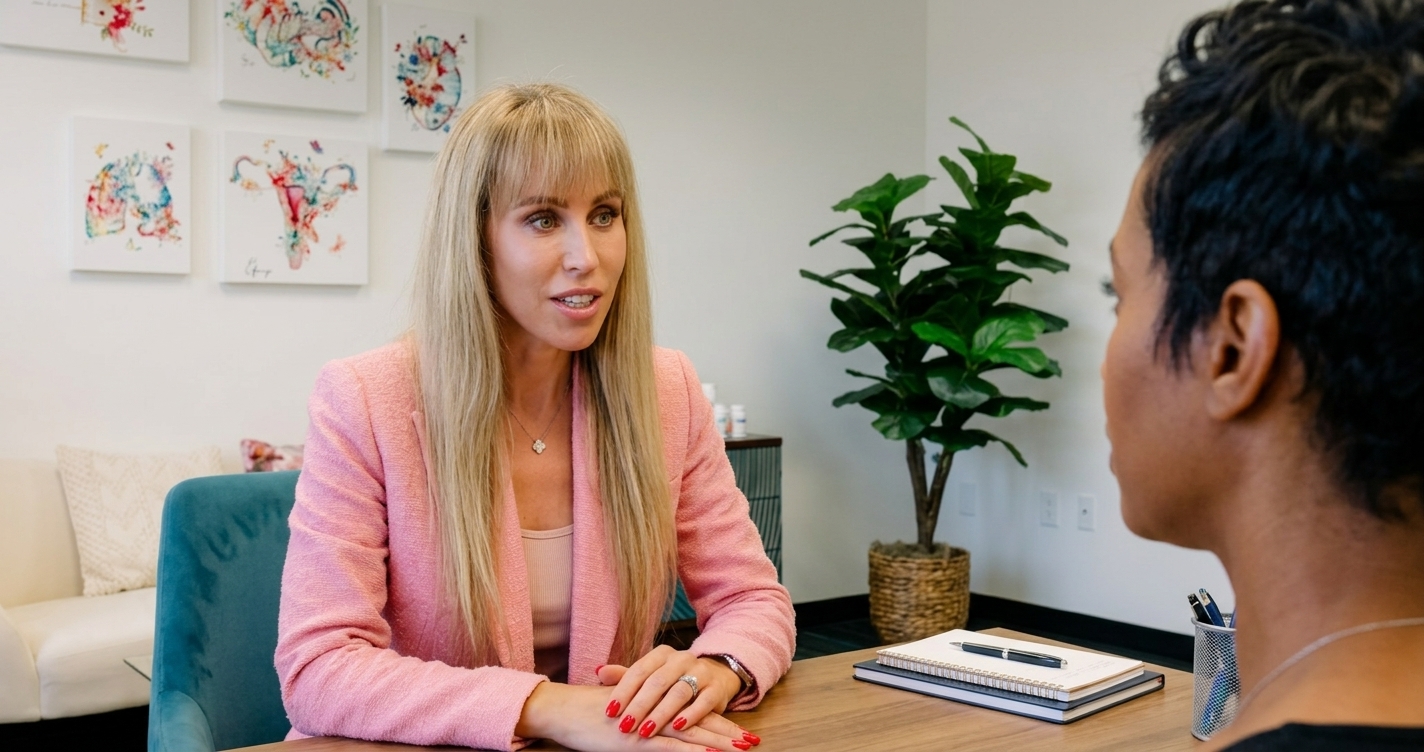
Is It Worth Hiring a Dietitian for Hashimoto’s? Here’s My Honest Answer
You probably typed this question into Google at 11 p.m., after another day of doing everything right and still feeling wrong. Your TSH is “normal.” Your doctor says you’re fine. And you’re sitting there wondering whether paying someone to talk to you about food is a smart investment or just one more thing that won’t work.
First, the obvious disclosure: I am a dietitian who works with women with Hashimoto’s. Of course I think this work matters. So instead of pretending I’m neutral, I’m going to do something more useful. I’m going to tell you exactly who benefits from hiring a Hashimoto’s dietitian, who does not, and how to tell the difference before you spend a dollar.
The bottom line is this: hiring a dietitian is worth it if you are still symptomatic on medication, if your labs keep coming back “normal” while you feel anything but, or if you have been piecing together advice from the internet for more than six months without a clear result. It is not worth it if you want someone to hand you a meal plan, or if you’re not ready to run a real experiment on your own body. Let me explain both.
Why “Normal TSH” Is Not the End of the Story
Levothyroxine replaces thyroid hormone. That is its job, and it does it well. What it does not do is address the reasons your immune system is attacking your thyroid in the first place, or the downstream problems that Hashimoto’s creates in your gut, your nutrient status, your liver, and your energy production.
That gap is why so many women feel stuck. Research reviewed by the American Thyroid Association suggests that roughly 10 to 15 percent of people on levothyroxine continue to have symptoms despite a normal TSH, and some clinic studies put that number closer to 1 in 4. Fatigue and weight gain top the list. These women are not imagining it, and they are not “non-compliant.” They are simply being treated for one piece of a multi-system condition.
That is the piece a good dietitian is trained to work on.
What a Hashimoto’s Dietitian Actually Does (It’s Not a Meal Plan)
Most people picture a printed meal plan and a lecture about vegetables. If that’s all you’re getting, you’re not getting Hashimoto’s care. Here is what the work looks like when it’s done well:
- ✓ Reading your labs the way an endocrinologist doesn’t have time to. Not just TSH, but free T3, free T4, reverse T3, TPO and thyroglobulin antibodies, ferritin, vitamin D, B12, a full iron panel, and inflammation markers like CRP. Then interpreting them together, not one at a time.
- ✓ Finding the deficiencies that are quietly driving your symptoms. Iron and vitamin D are low in a large share of women with Hashimoto’s, partly because autoimmune gastritis and celiac disease are more common in this group and both impair absorption. Low ferritin alone can explain fatigue, hair shedding, and cold hands that get blamed on the thyroid.
- ✓ Checking whether your medication is even being absorbed. Coffee, calcium, iron, and certain gut conditions all interfere with levothyroxine. I have watched a client’s dose “stop working” because of a timing problem that took five minutes to fix.
- ✓ Investigating your gut. Bloating, constipation, and reflux are not side notes with Hashimoto’s. Your gut is where you absorb your nutrients and your medication, and where a large part of your immune system lives. Sometimes that means a food-based approach; sometimes it means a stool test like the GI-MAP to see what’s actually going on.
- ✓ Running clean food experiments instead of blanket restrictions. Not “go gluten-free forever.” A structured elimination with a baseline, a timeline, and a reintroduction, so you get an answer that belongs to your body.
- ✓ Coordinating with your prescriber. A good dietitian does not replace your doctor. She gives your doctor better information.
If you want a preview of how I think about this, my post on whether gluten is really bad for Hashimoto’s shows the experiment-first approach in detail.
Who Genuinely Benefits From Hiring a Dietitian
After more than a decade of doing this, I can tell within the first call whether someone is going to get their money’s worth. These are the women who do:
- You’re on medication, your TSH is “normal,” and you still feel terrible. This is the single biggest group I see. Your doctor has done their job. The rest of the picture has not been looked at.
- You’ve been gluten-free, dairy-free, or on a strict protocol for a year and nothing changed. Something in the setup was wrong: processed substitutes, the wrong supplements, or a deficiency nobody tested for. This is fixable, but usually not alone.
- You have gut symptoms no one connects to your thyroid. Bloating, constipation, reflux, or food reactions that showed up around your diagnosis.
- You’re losing hair, your periods have shifted, or you can’t lose weight no matter how little you eat. These are downstream signals, and they respond to root-cause work. (If weight is your main frustration, read why it’s so hard to lose weight with Hashimoto’s first.)
- You’ve spent more on supplements this year than a dietitian would cost. I say this gently: if your cabinet is full and you’re still tired, the problem is not a missing bottle. It’s a missing strategy.
Who Should NOT Hire a Dietitian (Yet)
This is the section most practitioners won’t write, and it’s the one I care about most. Please do not book with me, or anyone, if:
- You’re not willing to get labs done. Everything I do is built on your numbers. If the plan is to skip bloodwork and guess, you’ll get generic advice, and you can get that for free. (New to all of this? Start with what to do right after a Hashimoto’s diagnosis.)
- You want a meal plan and nothing else. That’s a fine thing to want, but it doesn’t require one-on-one clinical work. A course or a community will get you there for a fraction of the cost.
- You’re not able to commit to 3 to 6 months. Symptoms can shift within weeks, but antibodies and nutrient stores move slowly. Ferritin can take months to rebuild. If you can only do one session, you will get information, not transformation.
- Paying for it would create real financial stress. Chronic stress is its own driver of autoimmune flares. A plan you’re anxious about paying for will work against you. There are lower-cost ways to start, listed below.
- You have a symptom that needs a doctor first. A rapidly growing neck lump, severe depression, or unexplained weight loss are medical workups, not nutrition consults.
Dietitian vs. Nutritionist vs. Health Coach: Why the Letters Matter
A Registered Dietitian (RD or RDN) has completed an accredited degree, a supervised clinical internship, and a national board exam, and must keep up continuing education to stay credentialed. In most states, “dietitian” is a legally protected title. Dietitians are the only nutrition professionals trained and licensed to provide medical nutrition therapy for a diagnosed disease, and the only ones most insurance plans will reimburse.
A nutritionist, in many states, can be anyone. The word is often unregulated. Some nutritionists are brilliant and highly trained; some completed a weekend certificate. You cannot tell from the title alone.
A health coach is trained in behavior change and accountability. That is valuable, and I hold that certification myself, but coaching is not the same as interpreting a ferritin level. For Hashimoto’s, you want someone who can do all three: read labs clinically, apply medical nutrition therapy, and help you follow through. Ask for the credentials. Anyone legitimate will be happy to show them.
What About the Cost? Let’s Talk About It Directly
Working one-on-one with a specialist is an investment, and you deserve a clear way to think about it.
- Many insurance plans cover nutrition counseling with a registered dietitian. Coverage varies enormously, so call the number on your card and ask two specific questions: “Do I have a benefit for medical nutrition therapy?” and “Do I need a referral for it?” Some plans require a referral from your doctor; some don’t. Some cover a set number of visits per year.
- HSA and FSA funds can usually be used for dietitian visits when there is a diagnosis on file. Hashimoto’s is a diagnosis.
- Compare it to what you’re already spending. Add up the supplements, the “thyroid-friendly” products, and the online tests. For many of my clients that number is higher than expected, and it bought guesses instead of answers.
- Think in cost per result, not cost per session. Three months of focused work that resolves your fatigue is cheaper than three years of feeling 70 percent okay.
If the full one-on-one path isn’t right for you right now, that’s completely fine. Lower-cost ways in include the Hashimoto’s Healing Hub community, my self-paced courses, and the podcast, which is free and covers nearly every question I’ve ever been asked. Start where you are.
How to Choose the Right Dietitian for Hashimoto’s
Not every dietitian specializes in autoimmune thyroid disease, and that specialization matters. Here is how I would vet someone if I were in your shoes:
- Ask what labs they look at. If the answer is “whatever your doctor ran,” keep looking. You want free T3, reverse T3, both antibodies, ferritin, vitamin D, and a full iron panel at minimum, from someone who knows when to pause supplements before bloodwork.
- Ask how they decide whether to remove a food. The right answer involves testing, a timeline, and reintroduction. The wrong answer is a list of foods everyone with Hashimoto’s must avoid.
- Ask about the gut. Any Hashimoto’s specialist should be comfortable talking about absorption, motility, and when a stool test like the GI-MAP is worth running.
- Ask whether they work with your prescriber. You want collaboration, not a practitioner who tells you to ignore your doctor.
- Ask what “better” looks like in three months. A good clinician will give you concrete markers: steadier energy, fewer gut symptoms, a ferritin trending up, antibodies moving in the right direction. Vague promises of “healing” are a red flag.
- Notice how they make you feel on the call. If you leave feeling scared, shamed, or sold to, that is your answer.
The Mistakes That Make People Say “A Dietitian Didn’t Help”
I have heard “I tried a dietitian and it didn’t work” many times. When I dig in, it is almost always one of these:
They saw a generalist, not a specialist
A dietitian who mostly works with diabetes or sports nutrition is a wonderful professional and the wrong fit for Hashimoto’s. Autoimmunity, the gut, and thyroid hormone conversion are a specific skill set.
They went once
One session gives you a plan. The follow-up, where the plan gets adjusted to your actual labs and your actual life, is where results live.
They expected the antibodies to drop in six weeks
Symptoms can shift in weeks. Antibodies move slowly. For a meaningful read on TPO, you retest closer to the three-month mark. Even a 20 to 30 percent downward trend is a real, encouraging signal.
A Client Story: “I Wish I’d Done This Two Years Ago”
This is a composite of many clients, not one person, but the pattern is so common it deserves telling.
A woman in her early forties books a call after two years of trying to fix her fatigue alone. She is gluten-free, dairy-free, on eleven supplements, and exhausted. Her TSH is 1.8. Her doctor is pleased.
We run the labs nobody had run. Her ferritin is 14. Her vitamin D is 19. She has been taking her levothyroxine with her morning coffee and her iron supplement at the same time, so neither was being absorbed well. Her “gluten-free” diet is mostly bean-flour crackers and bars that are fermenting in her gut and causing the bloating she thought was thyroid.
None of this required a miracle. It required someone looking at the whole picture. Three months later she has energy at 3 p.m., her hair has stopped shedding in the shower, and she’s taking four supplements instead of eleven. Her exact words: “I wish I’d done this two years ago.”
The two years are what bother me. That is a long time to feel like a stranger in your own body when the answers were sitting in a blood draw.
Frequently Asked Questions
Can a dietitian help with Hashimoto’s?
Yes, particularly if you still have symptoms on medication. A dietitian who specializes in Hashimoto’s addresses the nutrient deficiencies, absorption problems, gut issues, and inflammation that thyroid hormone replacement does not treat, working alongside your prescribing doctor.
Does insurance cover a dietitian for Hashimoto’s?
Often, yes, but coverage varies by plan. Call your insurer and ask specifically about “medical nutrition therapy” benefits and whether a referral is required. HSA and FSA funds can typically be used for dietitian visits when there is a diagnosis.
What’s the difference between a dietitian and a nutritionist for thyroid problems?
A registered dietitian (RD/RDN) has completed an accredited degree, a supervised clinical internship, and a national board exam, and is licensed to provide medical nutrition therapy. “Nutritionist” is unregulated in many states and can mean anything from extensive training to a short online course. For a diagnosed autoimmune condition, look for the RD or RDN credential.
How long does it take to see results working with a Hashimoto’s dietitian?
Most clients notice changes in energy, digestion, or sleep within the first few weeks. Lab markers like ferritin and thyroid antibodies move more slowly and are usually rechecked around the three-month mark. Plan on three to six months of focused work for lasting change.
Should I see a dietitian before or after starting thyroid medication?
Either. You do not need to wait for your dose to be “perfect.” Nutrition work and medication work on different parts of Hashimoto’s, and a dietitian can help from day one with absorption, timing, and the deficiencies that make it harder to find your right dose. The only rule is that your prescriber stays in charge of the medication.
Not Sure Yet? I Made You a Free Checklist
If you’re still deciding, I put the exact questions I would want you to ask any practitioner, including me, into a one-page checklist: credentials, labs, food philosophy, gut testing, cost, and the red flags that mean you should walk away.
Want it? Download it here: Download the Free Hashimoto’s Dietitian Interview Checklist
The One Thing I Want You to Remember
Hashimoto’s is a multi-system autoimmune condition, and you deserve care that treats it that way. Medication handles the hormone. Someone still needs to handle the gut, the deficiencies, the absorption, and the inflammation. That can be a good dietitian, or you with the right tools, or both.
So is it worth hiring a dietitian for Hashimoto’s? For the woman who is still tired with normal labs, who has been guessing for months, who is ready to run a real experiment with real support, yes. Wholeheartedly. For the woman who just needs a starting point, start free, start small, and come find me when you’re ready.
Either way, your symptoms are not in your head. They’re in your data. Someone just has to look.
Want to go deeper? I break down the research, interview experts, and share practical tools you can actually use on the Hashimoto’s Nutrition Rx® Podcast, with new episodes for nearly every question you have. You can also find 60+ videos on my YouTube channel, Hashimoto’s Nutrition Rx, covering just about every Hashimoto’s topic I’ve ever been asked about.
👉 Ready to find out if we’re a fit? Schedule a call with me at All Purpose Nutrition 👈
Nataliia Sanzo, RDN • Registered Dietitian • Licensed Nutritionist • Host of the Hashimoto’s Nutrition Rx® Podcast
This article is educational and is not medical advice, diagnosis, or treatment, and does not replace care from your own licensed provider. Do not start, stop, or change any medication, including thyroid medication, without your prescriber.
