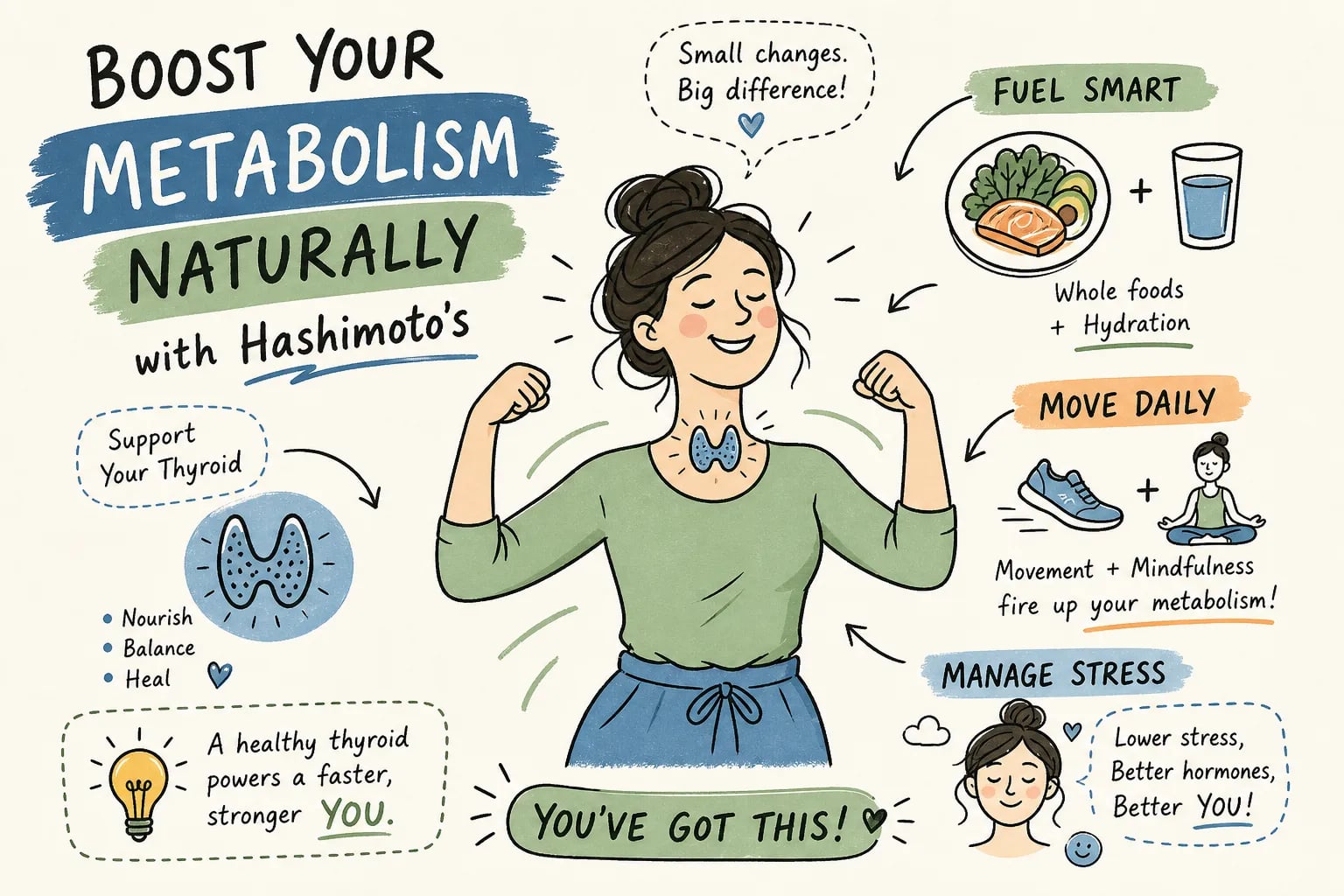
You’re eating well, moving your body, and doing everything the internet told you to do, yet your metabolism still feels like it’s running through wet concrete. If you have Hashimoto’s thyroiditis, that frustration is not in your head, and it’s not a willpower problem. If you’re wondering how to speed up your metabolism naturally with Hashimoto’s thyroiditis, the answer starts with understanding the specific mechanisms that slow it down in the first place, not just doing more of the generic advice that was never built for your condition.
This article covers five areas that directly affect metabolic rate in Hashimoto’s: how the disease impacts your calorie burn, what to eat to support thyroid hormone conversion and muscle mass, which type of exercise actually raises resting metabolism, which supplements have real evidence behind them, and how sleep and stress are quietly sabotaging your progress. Each section gives you something specific to work with, not a vague list of wellness tips.
Why Hashimoto’s Makes Metabolism Feel Sluggish
Thyroid hormones, particularly the active form T3, are primary regulators of your basal metabolic rate, meaning the calories your body burns at rest. They also control thermogenesis and energy production at the cellular level. When Hashimoto’s progresses to overt hypothyroidism, resting energy expenditure can fall significantly. One published study found that hypothyroid patients averaged just 1,210 kcal/day in resting energy expenditure compared to 1,400 kcal/day in people with normal thyroid function. That 190-calorie daily gap adds up fast, and no amount of discipline compensates for a physiology running below its set point.
Here’s the nuance that most general advice misses: if your thyroid hormone levels are still within normal range (euthyroid Hashimoto’s), the antibodies themselves don’t appear to significantly lower basal metabolic rate on their own. The metabolic impact is driven by thyroid hormone deficiency, not the autoimmune diagnosis alone. That distinction matters because it tells you the goal isn’t just “fixing your thyroid numbers.” It’s optimizing the downstream metabolic effects, and that requires a more layered approach.
When Autoimmune Hypothyroidism Actually Lowers Your Calorie Burn
The metabolic symptoms of Hashimoto’s-driven hypothyroidism are predictable once you understand the mechanism. Weight gain that doesn’t respond to caloric restriction, cold intolerance, constipation, fatigue that no amount of sleep fixes, and a resting heart rate on the lower end of normal are all downstream signals that thyroid hormone production or conversion is compromised. These aren’t separate problems, they’re one problem expressing itself in multiple systems at once.
The Role of T4-to-T3 Conversion in Resting Energy Use
Most of the thyroid hormone your body produces is T4, an inactive storage form. It has to be converted to active T3 in your tissues before it can influence metabolism. The primary conversion sites are the liver and kidneys, but a meaningful portion of that conversion, roughly 20% according to gut microbiome research, also happens in the gut via bacterial enzymes. This is why gut health is a metabolic issue in Hashimoto’s, not just a digestive one. A disrupted gut microbiome or compromised intestinal lining can reduce how much active T3 is available to your cells, even when your T4 or levothyroxine dose looks fine on paper.
How to Speed Up Metabolism Naturally With Hashimoto’s: Nutrition
The diet conversation in Hashimoto’s tends to get consumed by what to avoid: gluten, dairy, nightshades. What you eat to build and maintain the metabolic machinery matters just as much. The plate model that fits this condition best is half non-starchy vegetables, a quarter protein, and a quarter complex carbohydrates, with healthy fats added in. That structure isn’t arbitrary. It supports stable blood sugar, preserves lean muscle mass, and provides the substrate your gut and liver need for T4-to-T3 conversion.
Protein Targets That Protect Lean Muscle Mass
Lean muscle mass is one of your biggest drivers of resting metabolic rate. You can’t build or preserve it without adequate protein. For Hashimoto’s patients focused on metabolism and muscle preservation, clinical nutrition guidance points to a target of 1.6 to 2.0 grams of protein per kilogram of body weight per day, and up to 2.0 to 2.2 g/kg/day if you’re working in a caloric deficit. The best sources are fish, poultry, eggs, legumes, and Greek yogurt if you tolerate dairy. Spreading protein across your meals rather than loading it into one sitting also supports more stable blood sugar throughout the day, which matters for sustained energy and appetite regulation.
The Gut-Thyroid Connection Most Patients Overlook
Gut dysbiosis and increased intestinal permeability can reduce how much active T3 is systemically available, even when your T4 looks adequate. This happens through two pathways: impaired deiodinase activity that shifts conversion away from active T3, and inflammation from bacterial byproducts that worsen thyroid autoimmunity. Short-chain fatty acids produced by beneficial gut bacteria help maintain intestinal barrier integrity and immune regulation. When those bacteria are depleted, barrier function suffers. Prioritizing fiber-rich whole foods, fermented foods like kefir and sauerkraut (when tolerated), and reducing ultra-processed foods is a practical starting point for supporting both gut lining integrity and thyroid hormone availability.
Nutrient Timing and Meal Structure for Stable Energy
Skipping breakfast or going long stretches without eating can worsen the fatigue and blood sugar crashes that already come with hypothyroidism. A practical daily structure starts with thyroid medication taken on an empty stomach, then a breakfast built around protein, fat, and fiber roughly 30 to 60 minutes later. Meals built around those macronutrients, rather than refined carbohydrates alone, blunt glucose spikes and support more consistent energy output throughout the day. If you’re on levothyroxine, keep iron, calcium, and magnesium supplements at least four hours away from your medication, as they reduce absorption.
How to Speed Up Metabolism Naturally With Hashimoto’s: Exercise
Most people with Hashimoto’s gravitate toward walking, yoga, or light cardio, partly because fatigue makes higher-intensity work feel out of reach. Those activities support cardiovascular health and stress management, both worth doing. But they won’t significantly raise your resting metabolic rate. The research on this is direct: a meta-analysis found that resistance exercise increased resting metabolic rate by approximately 96 kcal/day, while aerobic exercise showed no significant effect on RMR. A 9-month resistance training program produced a roughly 5% increase in resting metabolic rate. That’s the lever that matters for sustained calorie burn when you’re not exercising.
Why Resistance Training Outperforms Cardio for Resting Metabolism
Lean muscle mass is the primary exercise-related driver of higher resting metabolic rate, and only resistance training builds it in a meaningful way. Cardio burns calories during the workout but doesn’t create the muscle tissue that keeps your metabolic rate elevated at rest. The 96 kcal/day increase from resistance training may not sound dramatic, but it compounds over time and shifts the metabolic baseline in a way that walking simply doesn’t. The goal isn’t to eliminate cardio, it’s to stop treating cardio as your primary metabolic strategy.
How to Structure Movement When Hashimoto’s Fatigue Is Real
Start with two to three resistance sessions per week on nonconsecutive days, centered on compound movements: squats, deadlifts, rows, and presses. These exercises recruit the most muscle mass and deliver the most metabolic return per session. Keep intensity in the moderate range, roughly 60 to 80 percent of your maximum effort, and aim for two to three sets of 8 to 12 repetitions per exercise. Progress load gradually rather than trying to maximize volume from the start. If you’re experiencing post-exercise fatigue that lasts more than 24 to 48 hours, that’s a clear signal to reduce intensity rather than push through it.
Supplements Worth Discussing With Your Provider
Supplementation for Hashimoto’s works best when it’s targeted to your confirmed deficiencies, not drawn from a generic wellness list. The nutrients below have the most direct evidence for thyroid function and metabolic support, but each one carries a caveat: testing before supplementing is essential.
Selenium and Zinc: What the Evidence Actually Shows
Selenium has the most direct Hashimoto’s-specific evidence of any supplement. Multiple meta-analyses show it can reduce TPO antibody levels, with the most consistently positive results coming from 200 mcg per day of L-selenomethionine used for three to six months. The research generally supports a safe study range of 80 to 400 mcg per day. However, a large retrospective cohort study found potential harms in patients who supplemented without a documented selenium deficiency, including higher TPO antibodies and worse outcomes. Test your baseline selenium status before supplementing, and do it with clinical guidance rather than self-prescribing.
Zinc plays a role in thyroid hormone metabolism and receptor sensitivity, making it relevant for Hashimoto’s patients. A supplemental range of 10 to 25 mg per day is generally considered reasonable for those with documented deficiency. Long-term use above 40 mg per day can deplete copper, which causes its own set of problems including anemia and neurologic symptoms. Both selenium and zinc matter for thyroid function, but supplementing without knowing your baseline status is guesswork that can backfire.
Vitamin D, Iron, and B12: Test Before You Supplement
Vitamin D deficiency is common in Hashimoto’s and can worsen immune dysregulation. Repletion makes sense when deficiency is confirmed, but vitamin D alone is not a treatment for thyroid autoimmunity. Iron is essential for thyroid peroxidase function, and low ferritin can worsen fatigue and mimic hypothyroid symptoms. If you’re on levothyroxine, taking iron at the same time reduces medication absorption, so keep them separated by at least four hours. B12 deficiency is more common in Hashimoto’s because of the overlap with autoimmune gastritis and pernicious anemia. Supplement when levels are low or borderline with symptoms, not as a blanket wellness strategy.
Sleep and Stress as Underrated Metabolic Levers
TSH secretion follows a circadian rhythm: levels naturally peak during sleep and drop during the day. When sleep is short, disrupted, or poorly timed, that nocturnal TSH surge is blunted, and downstream thyroid hormone levels can shift in ways that compound fatigue, weight gain, and impaired glucose regulation. This is a direct physiological mechanism, not a general “stress is bad for you” statement. Chronic cortisol elevation from ongoing psychological stress makes this worse by suppressing TRH and TSH secretion, flattening the pulsatile pattern of thyroid signaling, and shifting deiodinase activity toward lower T3 and higher reverse T3.
How Cortisol and Poor Sleep Disrupt Thyroid Signaling
The interaction between cortisol, sleep, and thyroid function creates a loop that’s hard to break without addressing all three simultaneously. Chronic stress worsens sleep continuity. Poor sleep raises sympathetic tone and cortisol the following day. Elevated cortisol suppresses pituitary TSH output and reduces peripheral T4-to-T3 conversion. The result is a biochemical picture that can look manageable on standard lab work while the patient continues to feel fatigued, metabolically sluggish, and unable to maintain a healthy weight, even with thyroid medication in place.
Practical Sleep and Stress Interventions That Work
Protecting sleep quality is one of the most underutilized levers for improving metabolic function in Hashimoto’s. Set a consistent sleep and wake time every day, including weekends, and protect seven to nine hours of uninterrupted sleep. Avoid bright light and screens at least 60 minutes before bed to support melatonin production. Use structured breathing or progressive muscle relaxation in the evening to lower bedtime arousal. Avoid high-intensity exercise within two to three hours of sleep. If snoring or persistent daytime sleepiness are present, a sleep study is worth pursuing, sleep apnea significantly worsens metabolic control and fatigue, and it’s underdiagnosed in women with thyroid disease.
Why Your Specific Metabolic Barriers Matter More Than General Advice
Hashimoto’s is not one uniform condition with one uniform metabolic problem. One person’s metabolism is stalled by low ferritin driving fatigue and impaired thyroid peroxidase function. Another has adequate nutrients but poor T4-to-T3 conversion driven by gut dysbiosis. A third has all the right labs but disrupted sleep architecture raising cortisol nightly. The standard advice to eat anti-inflammatory foods, exercise more, and reduce stress isn’t wrong, it’s just incomplete without knowing which of those barriers actually applies to you.
The Limits of One-Size-Fits-All Hashimoto’s Advice
Low ferritin, low T3, poor sleep, and vitamin D deficiency can all present as fatigue. Without testing, every intervention stays generic and results stay inconsistent, because you’re treating a category, not a person. Identifying the root cause of your specific metabolic slowdown changes the precision of every recommendation you apply. That’s not a small difference. It’s the difference between spinning your wheels for years and actually moving forward.
Getting to the Root Cause With Personalized Lab Work
Beyond standard TSH, useful markers for Hashimoto’s and metabolism include free T3, free T4, reverse T3, ferritin, vitamin D, selenium status, fasting insulin, and gut function markers. This is exactly the approach that drives the Hashimoto’s coaching programs at All Purpose Nutrition. Rather than applying a generic Hashimoto’s template, the programs are built around comprehensive lab review to identify each client’s specific metabolic barriers, then constructing a nutrition plan around those findings. If you’re not sure where to start, a free 15-minute discovery call is available to find the right program fit for where you are right now.
Pulling It All Together
Learning how to speed up your metabolism naturally with Hashimoto’s thyroiditis comes down to working with the specific mechanisms that are holding your metabolism back, not against them. Resistance training builds the lean muscle mass that drives resting calorie burn. Adequate protein and gut-supportive nutrition create the conditions for better T4-to-T3 conversion and stable energy. Sleep and stress management protect the hormonal environment where all of this works. And targeted supplementation fills specific gaps confirmed by lab testing, not general ones drawn from a wellness blog.
You don’t need more generic advice. You need the right information applied to your actual biology. If you’re ready to apply this to your specific situation, there are a few ways to go deeper. You can start with the Hashimoto’s Nutrition RX® podcast to build your foundational understanding, join the Hashimoto’s Healing Hub for ongoing education and community, or book a one-on-one program with All Purpose Nutrition to get a personalized plan built around your labs. The next step is the one that gets specific to you.
