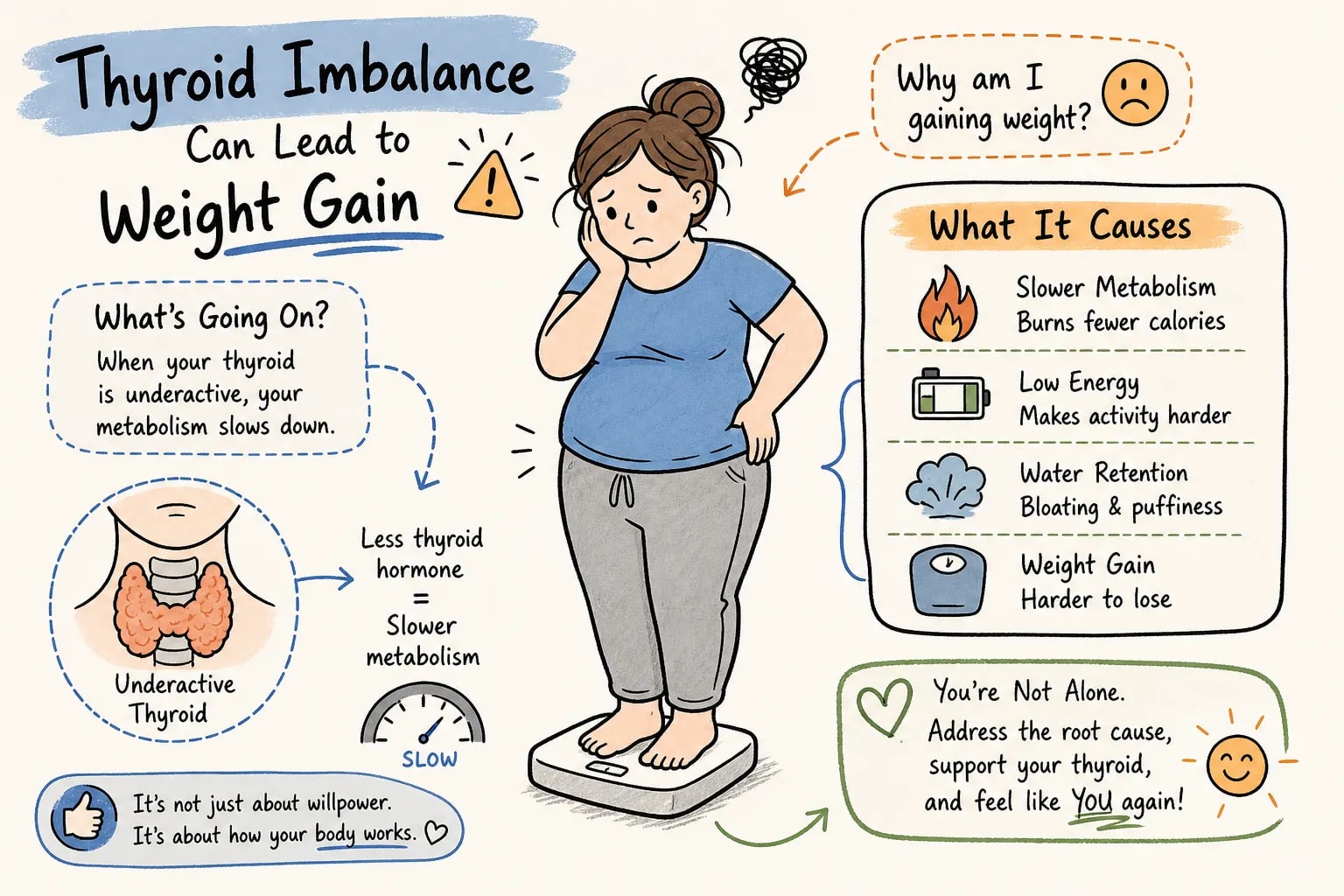
You’re eating carefully. You’re moving your body. You’re doing everything the standard advice tells you to do, and the scale either keeps climbing or refuses to budge. If you have Hashimoto’s or hypothyroidism, thyroid weight gain like this isn’t a failure of effort. It’s a failure of the advice itself, because that advice was never designed for what’s actually happening in your body.
Thyroid-related weight changes are among the most misunderstood and under-explained problems in women’s health. Generic calorie-cutting almost never solves thyroid weight gain because it ignores the real mechanisms at work: disrupted cellular energy production, fluid retention, insulin resistance, and chronic inflammation. At All Purpose Nutrition, this is one of the most common issues clients bring in, weight that won’t respond to conventional approaches because no one has addressed what’s actually driving it.
This article breaks down those drivers clearly and specifically, so you understand what low thyroid hormones are doing to your metabolism, how fluid distorts the scale, and what actually needs to happen for your weight to respond.
How low T3 slows your metabolism at the cellular level
Mitochondrial effects of low T3
T3, the active form of thyroid hormone, is your cells’ primary signal to burn fuel. It does this by binding to nuclear receptors (TRα and TRβ) that directly regulate the genes controlling mitochondrial function, oxidative phosphorylation, and thermogenesis. When T3 drops, mitochondrial activity slows across every major tissue in the body.
Specifically, T3 drives expression of PGC-1α and NRF-1, which promote mitochondrial biogenesis and increase the number and efficiency of respiratory chain proteins. It also increases uncoupling proteins like UCP1 in brown fat and UCP3 in skeletal muscle, which convert part of the energy generated by fuel burning into heat rather than ATP.
Thermogenesis and resting energy expenditure
This heat-generating process is called non-shivering thermogenesis, and it’s one of the ways your body burns calories that has nothing to do with exercise or conscious effort. When T3 is low, this process slows significantly and your resting energy expenditure drops, a direct contributor to thyroid weight gain that most calorie-counting approaches never account for.
This metabolic slowdown is biochemically distinct from simply being out of shape. Reduced fat oxidation is part of the picture too: low thyroid hormones impair the body’s ability to mobilize stored fat as fuel, making fat easier to accumulate and harder to burn. Add to that the fatigue that drives down physical activity, and you have a compounding effect that makes standard calorie math almost irrelevant until thyroid function is addressed.
Fat vs. fluid: what thyroid weight gain is really showing you
Not all weight gain from hypothyroidism is body fat. For many people with untreated or undertreated thyroid dysfunction, a significant portion of the scale increase is water and salt retention. This distinction matters for how you interpret your weight, how you evaluate treatment response, and which interventions are actually useful.
Why thyroid weight gain can be fluid, not fat
The fluid mechanism in hypothyroidism involves two overlapping processes. First, low thyroid hormone reduces renal blood flow and alters how the kidneys handle sodium and water, leading to systemic fluid retention. Second, hypothyroidism promotes accumulation of hyaluronic acid and other glycosaminoglycans in the dermis and connective tissue. These molecules are hydrophilic, meaning they bind water in the interstitium and create the characteristic firm, non-pitting edema seen in myxedema. This is the mechanism behind facial puffiness, swollen hands, and the doughy texture that many hypothyroid patients notice and can’t explain.
Clinically, most people with untreated hypothyroidism gain roughly 5 to 10 pounds attributable to the thyroid, and a meaningful portion of that is fluid rather than fat. Severe or prolonged hypothyroidism can cause more. Normal scale fluctuation runs about 1 to 5 pounds over a few days from hydration, sodium intake, bowel contents, and menstrual cycle changes. Gradual, persistent gain accompanied by fatigue, cold intolerance, constipation, and dry skin is a different pattern entirely, one worth investigating with proper lab work rather than another round of calorie restriction.
Insulin resistance and inflammation: the compounding drivers
Low thyroid function doesn’t slow metabolism in isolation. It creates downstream effects that make thyroid-related weight gain worse and weight loss harder. Two of the most significant are insulin resistance and chronic low-grade inflammation. For women with Hashimoto’s thyroiditis specifically, both are active players that most conventional thyroid management never touches.
When T3 is low, insulin-stimulated glucose uptake slows in muscle and fat cells. The PI3K-AKT pathway, which normally moves GLUT4 transporters to the cell surface to allow glucose entry, becomes less responsive. The result is that the pancreas has to produce more insulin to move the same amount of glucose. Higher circulating insulin promotes fat storage, particularly abdominal fat, and directly suppresses fat burning. This cycle can persist even after TSH is “normalized” if free T3 remains suboptimal at the tissue level.
The Hashimoto’s-specific layer makes this more complex. The immune system in Hashimoto’s is chronically active, generating cytokines including TNF-α, IL-1β, IL-6, and IFN-γ. These cytokines do more than damage thyroid tissue. They activate NF-κB and JAK/STAT pathways that interfere with thyroid hormone receptor signaling, inhibit hepatic conversion of T4 to active T3 (favoring the inactive reverse T3 instead), and further impair insulin signaling in muscle and fat. Cells can become less responsive to thyroid hormone even when blood levels appear adequate. This is why a normal TSH doesn’t always mean the thyroid is doing its job at the tissue level, and why addressing inflammation through targeted nutrition is a core clinical strategy rather than an optional add-on.
What your lab results actually reveal about thyroid weight issues
Most women who arrive frustrated about thyroid-related weight gain have had TSH checked once, been told it was normal, and sent home. TSH alone gives an incomplete picture, particularly for weight and metabolism. Understanding which labs matter, and what “optimal” looks like versus simply “in range”, is essential for figuring out whether the thyroid is contributing.
Standard diagnostic thresholds work as follows: overt hypothyroidism is defined by a TSH above the lab’s reference range paired with a free T4 below range. Subclinical hypothyroidism weight changes show up when TSH is elevated, typically between 4.5 and 10 mIU/L, with free T4 still within range. Most labs set the upper TSH limit around 4 to 4.5 mIU/L. TSH elevations above 10 mIU/L typically warrant treatment regardless of symptoms; elevations between the upper limit and 10 mIU/L are usually confirmed with repeat testing over 2 to 3 months before committing to treatment, unless symptoms, TPO antibodies, or cardiovascular risk factors are present.
Free T3 is the piece most often missing from a standard thyroid workup, and it’s the most directly connected to the metabolic effects described throughout this article. Many women with Hashimoto’s have TSH results within the lab reference range but suboptimal free T3, elevated TPO antibodies, and ongoing autoimmune activity driving symptoms. Being “in range” is not the same as being optimal. Symptoms and the full lab pattern matter alongside individual numbers, which is why a personalized lab review produces a clearer picture than a one-line result from a patient portal.
Realistic expectations when thyroid treatment starts
Starting levothyroxine doesn’t automatically reverse thyroid weight gain. Understanding the clinical data on this helps set realistic expectations and prevents the frustration of assuming treatment isn’t working when it’s actually doing what medication can do.
Research suggests average weight loss after starting levothyroxine falls in the range of 1 to 5 kg, with substantial individual variation. In one year-long study of newly diagnosed hypothyroid patients, average weight dropped from 83.7 to 79.4 kg, roughly 4.3 kg, but fat mass remained essentially unchanged. A separate six-month study found resting energy expenditure increased by approximately 144 kcal per day, but fat mass showed no significant reduction. What’s changing on the scale is largely fluid. Levothyroxine corrects the metabolic and renal abnormalities that cause water retention, producing early scale drops that can look promising but don’t reflect fat loss. Subclinical hypothyroidism shows even less response.
Once TSH is corrected, weight regulation for most people becomes similar to that of people without thyroid disease. That means the underlying body composition challenge doesn’t disappear with a prescription. Persistent weight issues after thyroid levels normalize usually have additional root causes: insulin resistance, ongoing inflammation, dietary patterns, sleep quality, cortisol dysregulation, and gut health. This is where nutrition strategy becomes essential, not a secondary consideration.
Getting to the root cause instead of cutting calories harder
A root-cause approach to thyroid weight gain starts with reviewing the full thyroid and metabolic lab picture, then building a nutrition strategy that addresses the specific mechanisms driving the problem. That looks very different from reducing calories and hoping for the best.
Practically, it means distributing protein across meals to protect muscle mass and support resting metabolism, particularly important given the muscle-loss risk from prolonged hypothyroidism. It means building anti-inflammatory food patterns that reduce the autoimmune burden driving cytokine activity. It means addressing carbohydrate quality to improve insulin sensitivity rather than eliminating carbohydrates entirely. And it means identifying and correcting the nutrient deficiencies that compound Hashimoto’s symptoms, including ferritin, vitamin D, selenium, and zinc, all of which affect thyroid hormone production, conversion, or immune regulation directly. These are targeted strategies grounded in mechanism. They’re not interchangeable with a calorie-restricted meal plan, which often worsens fatigue and muscle loss without touching the underlying dysfunction.
This is exactly where working with a Hashimoto’s-specialized registered dietitian changes the outcome. At All Purpose Nutrition, clients with thyroid weight gain concerns don’t get a generic plan. The process starts with a full review of thyroid labs, metabolic markers, and symptoms, and the nutrition strategy is built around what that data actually shows. If you’ve been told your labs are normal while still feeling terrible and watching your weight climb, that’s not the end of the conversation. It’s the beginning of a more specific one. Reach out to the All Purpose Nutrition team to book a free 15-minute discovery call and find out what a personalized approach looks like for your specific situation.
The bottom line on thyroid weight gain
Thyroid weight gain is real, but it’s more nuanced than a simple “slow metabolism” explanation. Low T3 reduces cellular energy production and fat oxidation. Fluid retention, driven by hyaluronic acid accumulation and altered kidney function, distorts the scale independently of fat. Insulin resistance and Hashimoto’s-driven inflammation layer on top, making weight loss harder even after TSH normalizes. And levothyroxine, while it corrects the metabolic abnormalities, rarely produces meaningful fat loss on its own.
The missing piece for most people isn’t a harder calorie cut. It’s a nutrition strategy that actually addresses the mechanisms driving the weight. Start by getting a complete thyroid panel, not just TSH. Track your symptoms alongside your labs. And seek support from someone who understands how Hashimoto’s and hypothyroidism interact with weight specifically, rather than applying population-level advice to a highly individual problem.
If you’re ready for a personalized approach rather than another generic plan, All Purpose Nutrition offers one-on-one consultations, lab-based nutrition planning, and 8-week coaching programs designed specifically for women navigating thyroid and autoimmune health. Get in touch to get started.
